Kiln-Roulette & Bucolism: A Talk on Rita G. Rivera’s House of Trees

Kiln-Roulette & Bucolism: A Talk on Rita G. Rivera’s House of Trees

By Maria Yigouti

By Maria Yigouti

/

/

Oct 10, 2025

Oct 10, 2025

Far from mild romantic frivolity, ceramics, reclaimed as art, reassert their craggy poetry. A rogue fleck, a warped lip — all part of the charm, records of what’s undergone to exist. For this, Spanish ceramicist Rita G. Rivera cleared the shelf of the ubiquitous, choosing what endures: clay in its utmost affective earthiness. Where industrial design prizes perfection, Rivera restores the “active matter” agency of the handmade. Clay is no longer inert but participant — a rhetor that outlives its maker.

Reviving age-old methods practiced for millenniums, Rivera draws the Strait of Gibraltar to a seam of clay — Mediterranean in temperament, her inquiries kneading a shared, earthen tongue. Though settled among the hills of northern Morocco, her work has not sated her wanderlust; it channels it through combinations of coiling and paddling that punctuate the quasi-monastic bucolism of her routine in her atelier on the outskirts of Tetouan, a house of fig and medlar trees: The House Where Trees Dream.

As her first solo show, The House Where Trees Dream, opens at MCC Gallery, we caught up with Rita G. Rivera on "vaulted rooms”, kiln-roulette, and ancestral passations.

Maria Yigouti: "If I were asked to name the chief benefit of the house, I should say: the house shelters daydreaming, the house protects the dreamer, the house allows one to dream in peace,” wrote Gaston Bachelard. To what extent does your inaugural exhibition draw on your atelier, perched on a hill and surrounded by olive trees, violets, and poppies? How tonalized is your first solo show to the modes of your inner space and its pastoral context?

Rita G. Rivera: Every exhibition has its own intimacy. Mine springs from the hills around our workshop near Tetouan, a small house that’s more than a workspace, as it breathes our way of being. My practice may start in that rurality: its pace and humility pressed into clay, yet it manages to get emotional. I try to blur authorship and reach for a universal sentiment.

The installation follows the same trajectory. The room opens with a series of jugs, wafting the atelier’s slow patina and earthy mist. At the center of the annex, the sculpture You Said You Love Me lies strewn, flowers scattered across the floor — a direct analogy to love’s fragility and passion’s frailty. This sense of scattering, fugacity, continues in the subsequent installation of engraved ceramic plaques: an emotional archive of private exchanges, literary lines, and song lyrics laid under glass. Photographs of winding paths, a blazing sun, and abysmal craters extend the scenography from its rootedness to the cosmic.

I conceived it all to envelop the visitor, stirring latent emotions. In a sense, the exhibition is that “vaulted room” Bachelard describes — a shelter for the dreamer, where the intimate and the infinite coexist.
Dom Pérignon vineyards from the sky
Vine leaf
Vine leaf
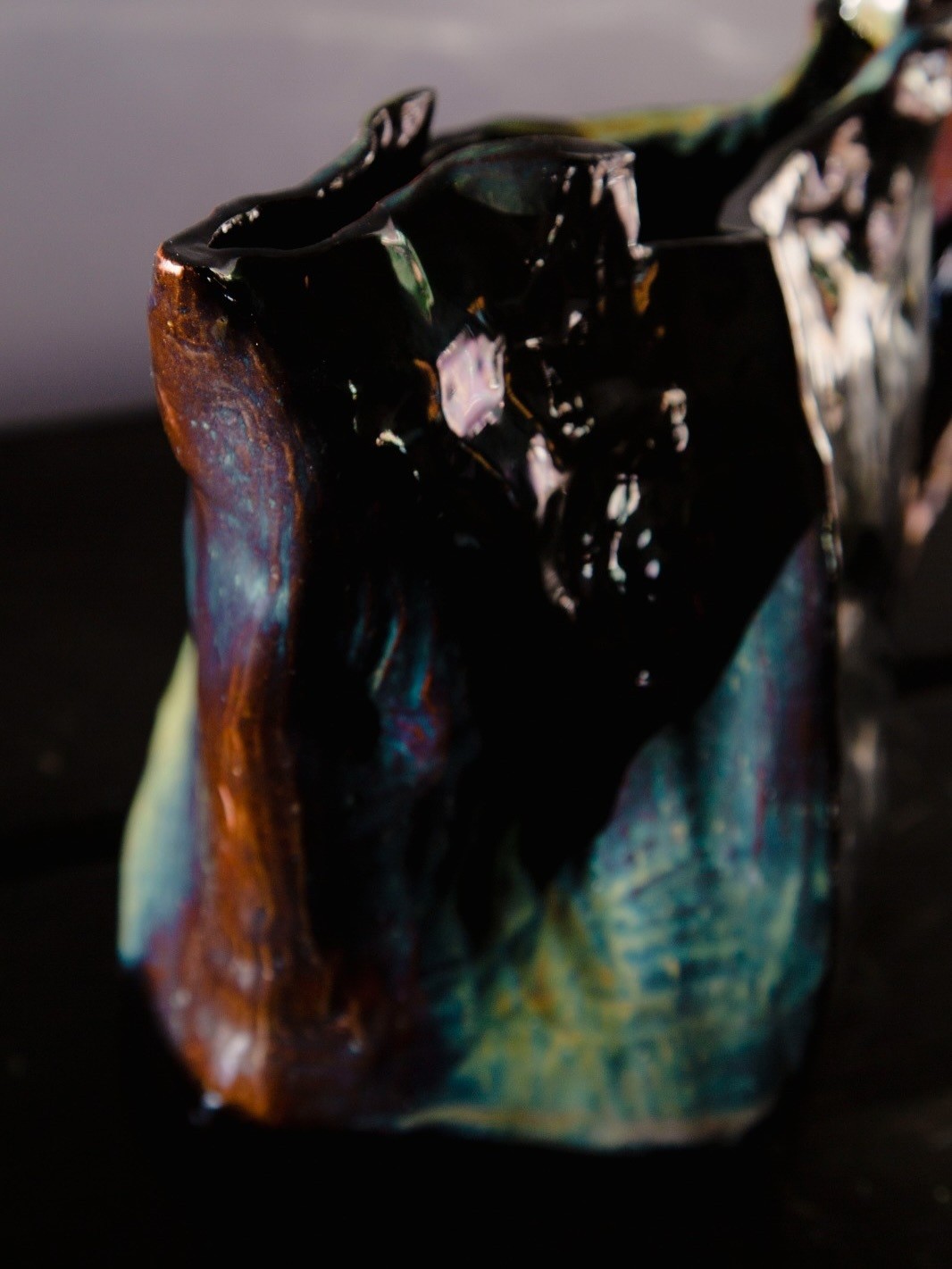
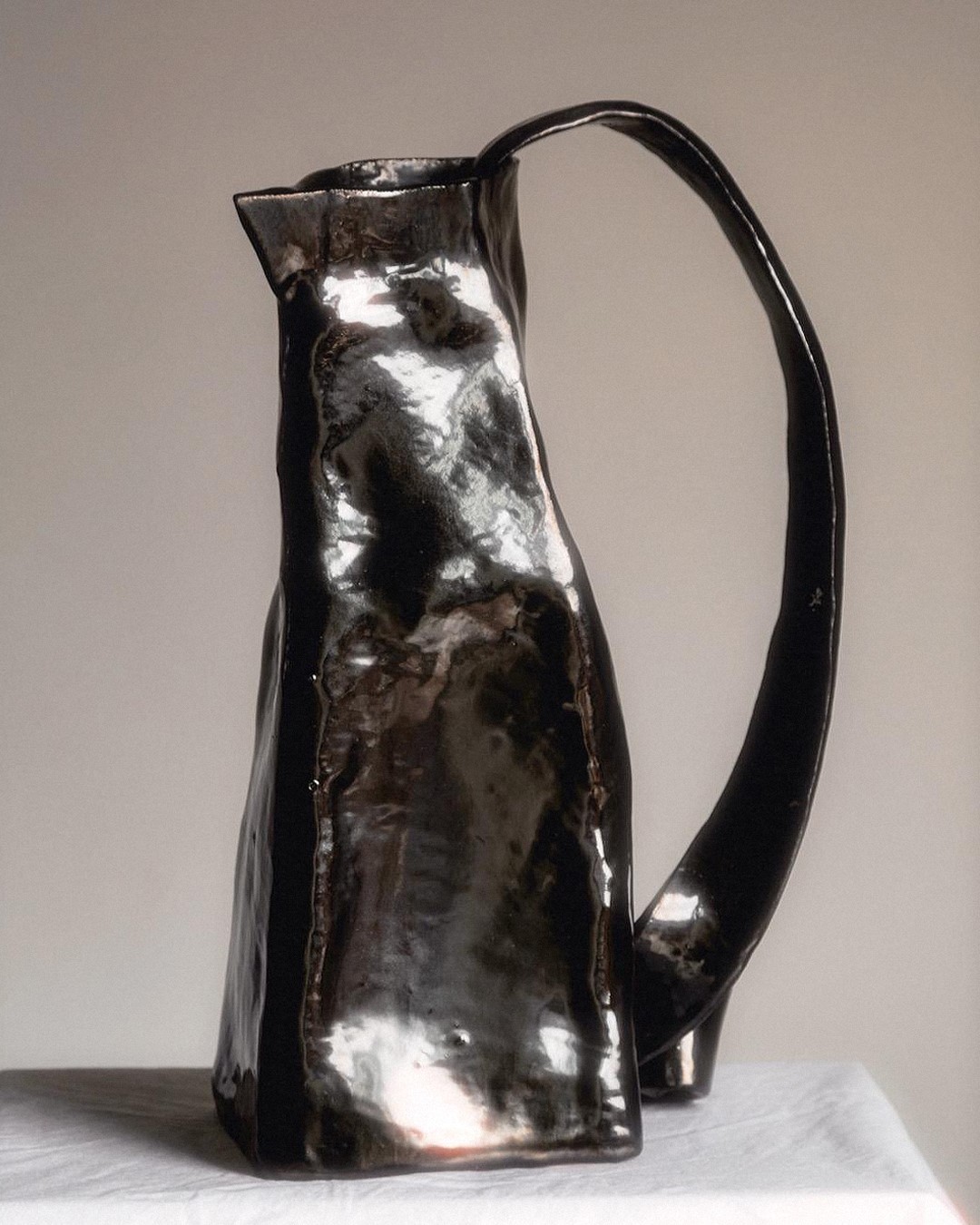
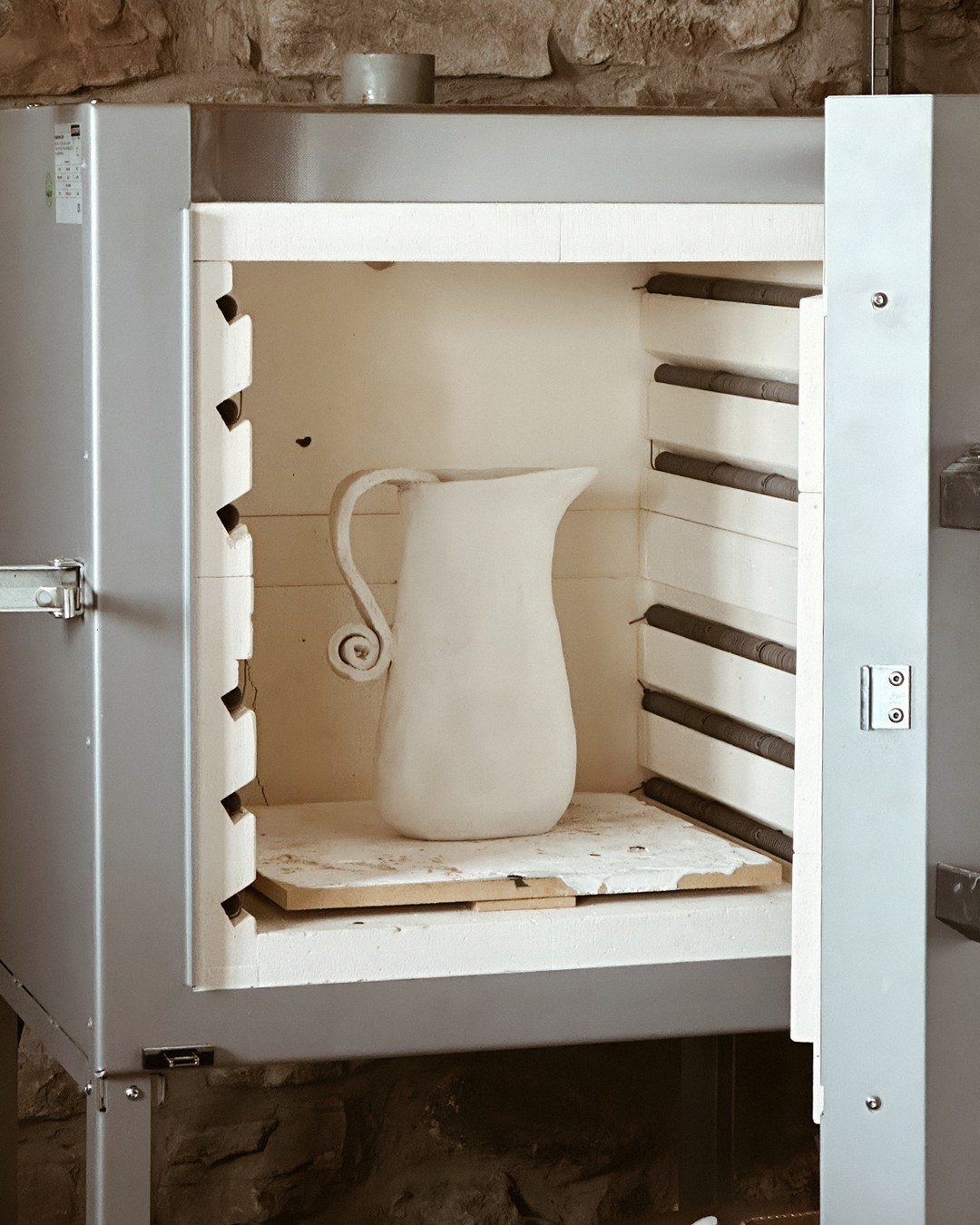
Rita G. Rivera, Geography of the Every Day II, glazed jug, 2025 (L/T); Geography of the Every Day IV, kiln view (R/B) © Courtesy of the artist.

M.Y: You’ve cultivated a vitalist materialism — an intuition receptive to subjectivity, bringing the clay’s latent creativity to life rather than reducing it to inert, utilitarian form. It’s a deliberate stand against obsolescence, aligned with the slow, anti-capitalist temporality of your practice and its critique of overconsumption. How do the jugs manifest this agency, tracing the affective and ethical ‘grains’ of your practice?

R.G.R: I’m profoundly moved by our humble, steady surroundings. Our neighbors, farmers, and shepherds often extend their kindness, offering bread or inviting us to share olives and eggs. Watching them work through the seasons, from yellowed, parched pastures to green valleys bursting with wildflowers, you see the deep bond they hold with their tools and the land. Nothing is disposable here; “use and throw away” has no place.

A knife, a jug, the Riffian mandil, even a simple chair can accompany someone for a lifetime. Later, that chair may be preserved reverently, enduring as a relic of the grandmother who sat there. As Fernando Broncano writes in Espacios de intimidad y cultura material: “It is perhaps the experience of poverty that illuminates the biographical condition of objects. Where each possessed thing is appreciated in itself and displayed as a mark of identity.”

That is exactly what fascinates me — objects that endure, that transcend. Across time, and still today in some communities, cherished possessions follow their owners to the grave. I think of objects as emotional artifacts, markers of identity, around which bonds form and fray. The jug incarnates this domestic universality: a vessel of water and sustenance, doubling as a capsule of recollection, a container of affection.

M.Y: Working with cobalt, manganese, and chromium instead of synthetic pigments, you resurrect ancestral glazing techniques while staking a signature chromatic range that throbs with clay’s sensorial alterity. How do you sustain the tension between know-how and desire, letting clay absorb, transmit, and materialize affect without ever subduing its fugitive character?

R.G.R: Truth is, I often start with a clear intention, but the work only comes alive when intuition takes over. The glaze is where control and surrender meet. I work with natural oxides, fickle in the kiln. That volatility is what draws me. Each firing is a wager; each kiln opening, a surprise. Matter decides — becomes what it was always meant to be: a waltz with unpredictability that needs no choreographer.

M.Y: You’ve cultivated a vitalist materialism — an intuition receptive to subjectivity, bringing the clay’s latent creativity to life rather than reducing it to inert, utilitarian form. It’s a deliberate stand against obsolescence, aligned with the slow, anti-capitalist temporality of your practice and its critique of overconsumption. How do the jugs manifest this agency, tracing the affective and ethical ‘grains’ of your practice?

R.G.R: I’m profoundly moved by our humble, steady surroundings. Our neighbors, farmers, and shepherds often extend their kindness, offering bread or inviting us to share olives and eggs. Watching them work through the seasons, from yellowed, parched pastures to green valleys bursting with wildflowers, you see the deep bond they hold with their tools and the land. Nothing is disposable here; “use and throw away” has no place.

A knife, a jug, the Riffian mandil, even a simple chair can accompany someone for a lifetime. Later, that chair may be preserved reverently, enduring as a relic of the grandmother who sat there. As Fernando Broncano writes in Espacios de intimidad y cultura material: “It is perhaps the experience of poverty that illuminates the biographical condition of objects. Where each possessed thing is appreciated in itself and displayed as a mark of identity.”

That is exactly what fascinates me — objects that endure, that transcend. Across time, and still today in some communities, cherished possessions follow their owners to the grave. I think of objects as emotional artifacts, markers of identity, around which bonds form and fray. The jug incarnates this domestic universality: a vessel of water and sustenance, doubling as a capsule of recollection, a container of affection.

M.Y: Working with cobalt, manganese, and chromium instead of synthetic pigments, you resurrect ancestral glazing techniques while staking a signature chromatic range that throbs with clay’s sensorial alterity. How do you sustain the tension between know-how and desire, letting clay absorb, transmit, and materialize affect without ever subduing its fugitive character?

R.G.R: Truth is, I often start with a clear intention, but the work only comes alive when intuition takes over. The glaze is where control and surrender meet. I work with natural oxides, fickle in the kiln. That volatility is what draws me. Each firing is a wager; each kiln opening, a surprise. Matter decides — becomes what it was always meant to be: a waltz with unpredictability that needs no choreographer.

Dom Pérignon vineyards from the sky
Vine leaf
Vine leaf
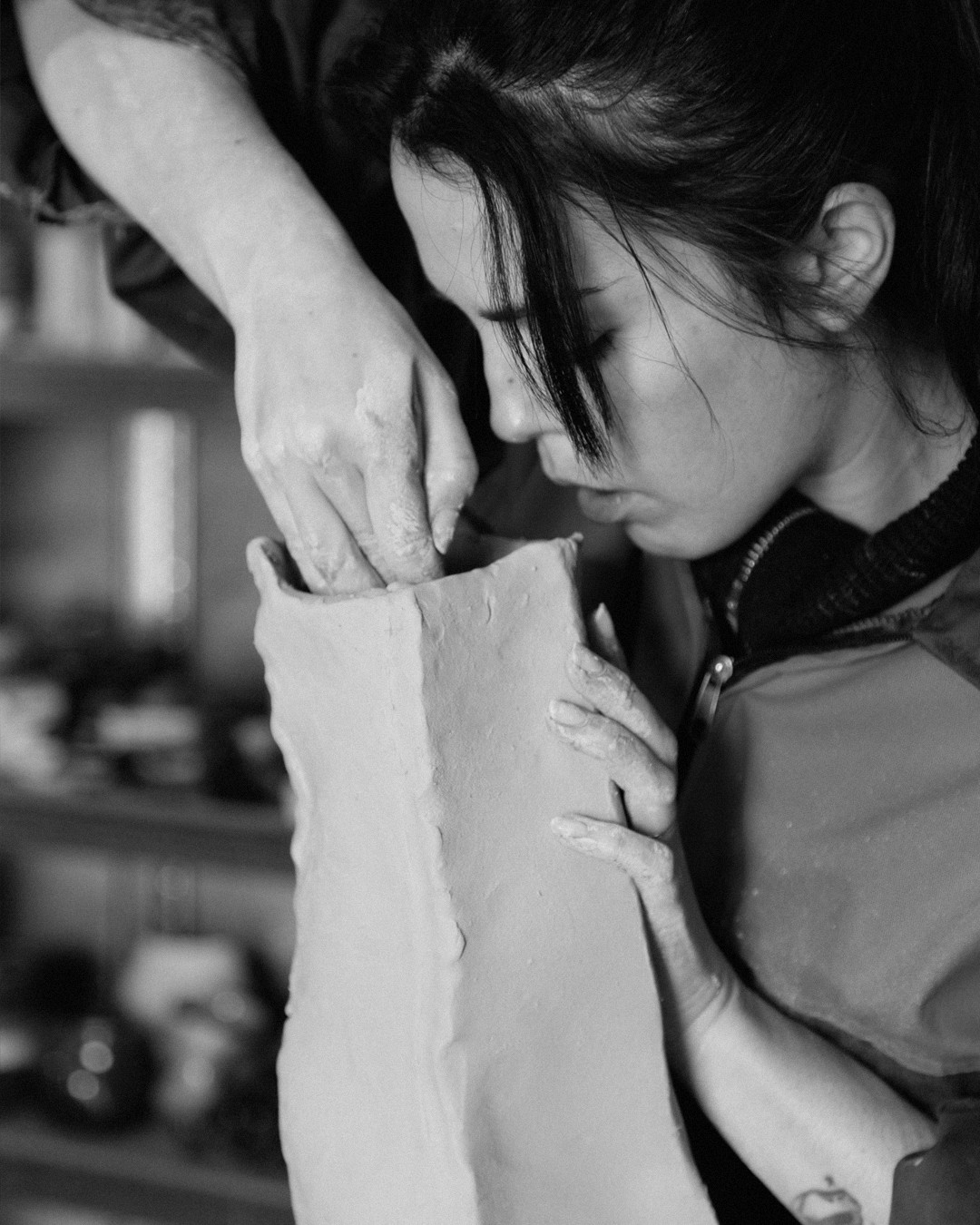
Rita G. Rivera, Geography of the Every Day I, glazed jug, natural oxide minerals, 2025 (L/T); Rivera in her atelier (R/B) © Courtesy of the artist.

M.Y: The practice of a ceramicist enacts forms of collective knowledge that evade direct transcription. Your ceramics, as “material archives,” render this knowledge tangible, recording not only ancestral techniques but the undercurrent of lived temporality. How do you revive and sustain these filiations, letting technique act as custodian of tradition, while simultaneously tracing the contours of your own creative path?

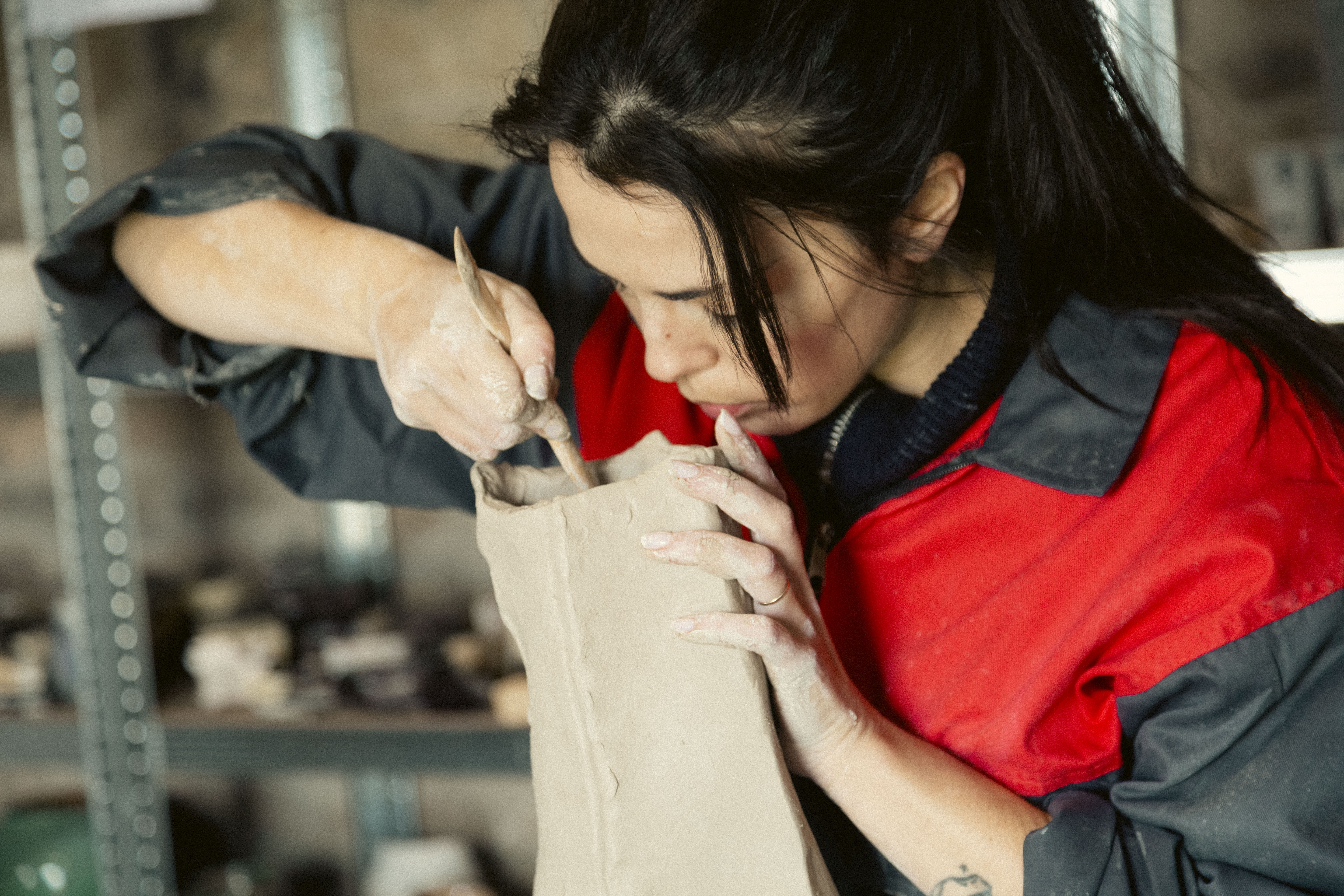
R.G.R: I’ve been living in Morocco for three years, and while my fascination with pottery and rural ceramics led my husband, Amine Asselman, and me to found Sania — a ceramic craft and design studio — my artistic research has since branched outward. At Sania, we work rooted in tradition: Amine investigates zellige, while I inquire into Riffian ceramics, a heritage passed from mother to daughter in northern Morocco. Practiced exclusively by women, this pottery has always stirred something in me with its fragile, arresting beauty. Over time, the ancestral designs have translated into pieces that feel personal and contemporary.

The work I’m showing at MCC steps beyond functional practice, venturing into concerns I’ve long explored through other media, like photography. The pieces shed utility to explore space as a facet of identity and the human condition. What keeps me tied to tradition, I think, is the hands-on work with clay — a primal, almost archaic gesture, digging deep into the unconscious.

M.Y: To borrow from Bachelard, who arguably slipped into our chat: “The fact is not enough; the dream is at work. When it comes to excavated ground, dreams have no limit.” He writes of one who “digs and re-digs,” turning depth into active ground. As you present your first solo exhibition — both excavation and revelation — how does it feel to let others enter that terra incognita you’ve press-formed and glazed?

R.G.R: I’m drawn to excavation and revelation. To dig, to sculpt, isn’t just about uncovering forms — it’s about unearthing layers of the imagination. Sculpting is a literal, forceful way of pressing word and thought into form. Working with clay grounds me; it gives weight to what might slip away. Ideas vanish like air furrows, but the soil keeps score. It holds the trace, making tangible what would otherwise remain suspended.

I want visitors to feel that intimacy — to step into a "vaulted" space, a place where they can be welcomed, receptive, connected.


+ Save the date: The House Where Trees Dream opens at MCC Gallery, Marrakech, on October 10, and remains on view through January 3, 2026.

Words Maria Yigouti

Give a Shout

M.Y: The practice of a ceramicist enacts forms of collective knowledge that evade direct transcription. Your ceramics, as “material archives,” render this knowledge tangible, recording not only ancestral techniques but the undercurrent of lived temporality. How do you revive and sustain these filiations, letting technique act as custodian of tradition, while simultaneously tracing the contours of your own creative path?

R.G.R: I’ve been living in Morocco for three years, and while my fascination with pottery and rural ceramics led my husband, Amine Asselman, and me to found Sania — a ceramic craft and design studio — my artistic research has since branched outward. At Sania, we work rooted in tradition: Amine investigates zellige, while I inquire into Riffian ceramics, a heritage passed from mother to daughter in northern Morocco. Practiced exclusively by women, this pottery has always stirred something in me with its fragile, arresting beauty. Over time, the ancestral designs have translated into pieces that feel personal and contemporary.

The work I’m showing at MCC steps beyond functional practice, venturing into concerns I’ve long explored through other media, like photography. The pieces shed utility to explore space as a facet of identity and the human condition. What keeps me tied to tradition, I think, is the hands-on work with clay — a primal, almost archaic gesture, digging deep into the unconscious.

M.Y: To borrow from Bachelard, who arguably slipped into our chat: “The fact is not enough; the dream is at work. When it comes to excavated ground, dreams have no limit.” He writes of one who “digs and re-digs,” turning depth into active ground. As you present your first solo exhibition — both excavation and revelation — how does it feel to let others enter that terra incognita you’ve press-formed and glazed?

R.G.R: I’m drawn to excavation and revelation. To dig, to sculpt, isn’t just about uncovering forms — it’s about unearthing layers of the imagination. Sculpting is a literal, forceful way of pressing word and thought into form. Working with clay grounds me; it gives weight to what might slip away. Ideas vanish like air furrows, but the soil keeps score. It holds the trace, making tangible what would otherwise remain suspended.

I want visitors to feel that intimacy — to step into a "vaulted" space, a place where they can be welcomed, receptive, connected.


+ Save the date: The House Where Trees Dream opens at MCC Gallery, Marrakech, on October 10, and remains on view through January 3, 2026.

Words Maria Yigouti

Give a Shout

Words Maria Yigouti

Mercurial Inquiries: El Haitout’s Chamber Orchestra of Color

Words Maria Yigouti

Mercurial Inquiries: El Haitout’s Chamber Orchestra of Color

Words Adrian Beim

In Praise of Idleness: 5 Ways To Outwit The Productivity Trap

Words Adrian Beim

In Praise of Idleness: 5 Ways To Outwit The Productivity Trap

Word Maria Yigouti

Madoda Fani & The Poetics of Manhood

Word Maria Yigouti

Madoda Fani & The Poetics of Manhood

Words Ilyass Saytli

LUAR Don’t Flirt. It Confronts, Con Amor

Words Ilyass Saytli

LUAR Don’t Flirt. It Confronts, Con Amor

Caught in a doomscroll?

Get on the Brosco Setlist for inbox-only exclusives and curatorially inclined collectibles.

Socials


Instagram

Spotify

About

88 St. Brosco is a full-fledged, archival-versed, and contemporary-slanted hub curating the poetics of niche artist lineages across disciplines.

Since its debut, 88 St. Brosco has nurtured a coterie of neophytes and devotees alike by collecting and bolstering the practice of artistic forces that negotiate both the brisk and the brash as modes of expression.


Contact


Submission

Inquiry

© 88 St. Brosco

Caught in a doomscroll?

Get on the Brosco Setlist for inbox-only exclusives and curatorially inclined collectibles.

Socials


Instagram

Spotify

Sitemap


Main

RAW

About

88 St. Brosco is a full-fledged, archival-versed, and contemporary-slanted hub curating the poetics of niche artist lineages across disciplines.

Since its debut, 88 St. Brosco has nurtured a coterie of neophytes and devotees alike by collecting and bolstering the practice of artistic forces that negotiate both the brisk and the brash as modes of expression.


Contact


Submission

Inquiry

© 88 St. Brosco